

- University
- Corporate governance
- Board of Directors
- Corporate Secretary
- Corporate events
- Corporate events calendar
- Meetings of the Board of Directors
- Committees of the Board of Directors
- Report on the activities of the Board of Directors
- Society’s annual report
- Board
- Board meetings
- Internal audit service
- Anti-Corruption Compliance Officer
- Decisions of the sole shareholder
- Annual financial statements
- Governance
- CHAIRMAN OF THE BOARD-RECTOR
- Academic council
- Assistant to the Chairman of the Board-Rector
- Advisor to the Rector on public relations
- Advisor to the Rector on administrative and legal issues
- Advisor to the Rector for youth affairs
- Human resource management
- Documentation Support and Archive Department
- Department of Economics and Finance
- Department of Economic Work
- Information Security Officer
- MEMBER OF THE BOARD - VICE-RECTOR FOR ACADEMIC AFFAIRS
- MEMBER OF THE BOARD-VICE-RECTOR FOR RESEARCH AND INTERNATIONAL RELATIONS
- Сhief editor
- Department of research coordination
- Commercialization Department
- Department of international relations
- Scientific сenter «Archeology and еthnography»
- Scientific center «Korkyt studies»
- Scientific centre «Mustafa Shokai»
- Laboratory of engineering profile «physicochemical methods of analysis»
- Scientific and educational center for chemical and biological research named after T.D.Kuanyshbaev
- Scientific and technical library
- Botanical garden and greenhouse facility
- MEMBER OF THE BOARD - VICE-RECTOR FOR SOCIAL AND EDUCATIONAL WORK
- Department of Social and Educational Work
- Department of Recruitment and Career
- Media center
- Psychological Support Center
- Medical Center
- The Center «Assembly of People of Kazakhstan»
- Palace of students
- Museum
- Sports complex «Seykhun»
- Student Ombudsman
- Council of veterans
- «Кorkyt ata endowment» сorporate fund
- Alumni Association
- BOARD MEMBER - VICE-RECTOR FOR STRATEGIC DEVELOPMENT AND IT
- CHAIRMAN OF THE BOARD-RECTOR
- Regulatory documents
- Mission of the University
- Positions in the ratings
- Accreditation
- Material and technical base
- Personnel reserve
- Graduates
- Corporate governance
- Rector's blog
- Education
- Science
- Students
- International relations
- Media
- SDG
- Sustainable development policy
- Action plans for the implementation of the policy in the field of Sustainable Development Goals
- Round table «Promoting Sustainable Development Goals through education and Research»
- A round table dedicated to the development of the green economy and construction was held at Korkyt Ata University
- A seminar was held for the teaching staff and employees of the university
- Workshop to discuss the 2025 Voluntary National Review for all stakeholders
- An eco-club has been established at Korkyt ata Kyzylorda University
- Mechanism for implementing the sustainable development policy
- Specialist in sustainable development goals
- Scientific projects
- International Center for the Study of Ecosystems of the Aral Sea Region
- Educational programs on sustainability
- Commissioners for Sustainable Development
- Center for Inclusive Education
- Solar power plant
- Inclusive infrastructure scheme
- Report on the implementation of the Sustainable Development Policy for the 2024-2025 academic year
- Report of Carbon Emission
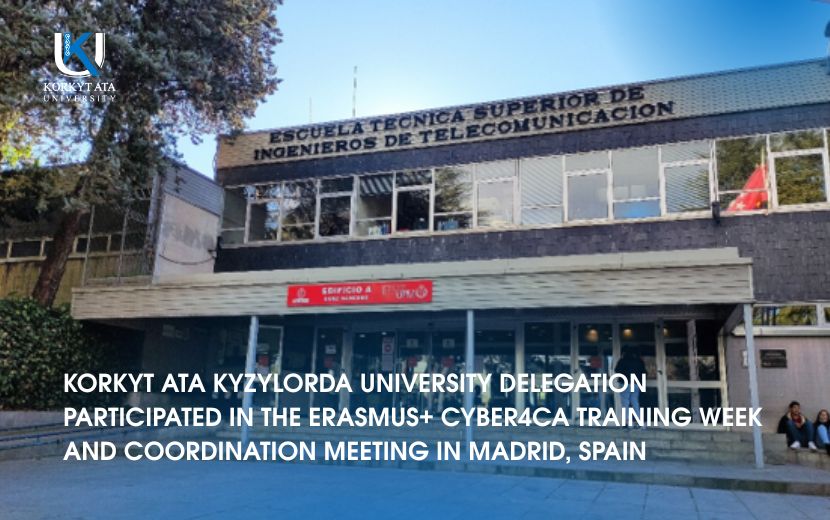
KORKYT ATA KYZYLORDA UNIVERSITY DELEGATION PARTICIPATED IN THE ERASMUS+ CYBER4CA TRAINING WEEK AND COORDINATION MEETING IN MADRID, SPAIN
The Korkyt Ata Kyzylorda University delegation participated in the Teaching Staff Training Week and Consortium Coordination Meeting for the period of June 15-19, 2026, organized within the framework of the Erasmus+ KA2 Capacity Building in Higher Education project “Development of Innovative Graduate Educational Program in Cyber Security for Digital Labor Market of Central Asia (Cyber4CA)”. The events were hosted by the Escuela Técnica Superior de Ingenieros de Telecomunicación (ETSIT), Universidad Politécnica de Madrid (UPM), Spain, one of Europe's leading engineering and technological universities.
The Training Week brought together representatives of higher education institutions, governmental organizations, and project partners from Spain, Belgium, Italy, Romania, Kazakhstan, Uzbekistan, and Kyrgyzstan. The consortium includes Universidad Politécnica de Madrid (Spain), University of Antwerp (Belgium), Scuola Superiore Sant'Anna (Italy), National University of Science and Technology POLITECHNICA Bucharest (Romania), International Information Technology University (Kazakhstan), Tashkent University of Information Technologies, Osh State University, Kyrgyz State Technical University, and other leading academic institutions and ministries participating in the Cyber4CA project.
The Cyber4CA project aims to strengthen higher education capacity in Central Asia by developing an innovative master's degree program in cybersecurity that meets the rapidly evolving demands of the digital labor market. The project focuses on curriculum modernization, the creation of advanced CyberLabs, the enhancement of teaching methodologies, the strengthening of international academic cooperation, and the improvement of the quality of cybersecurity education across Central Asian universities.
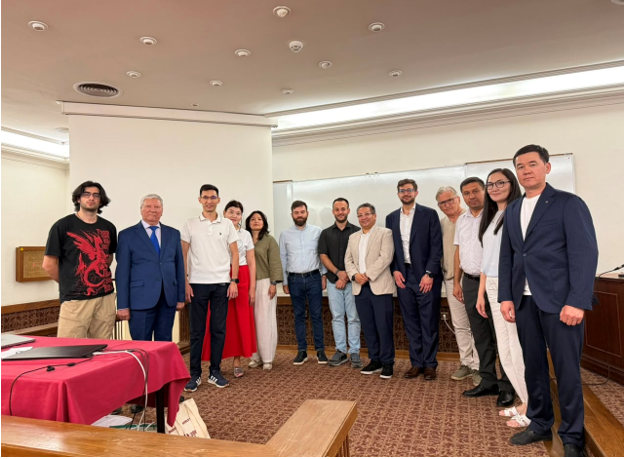
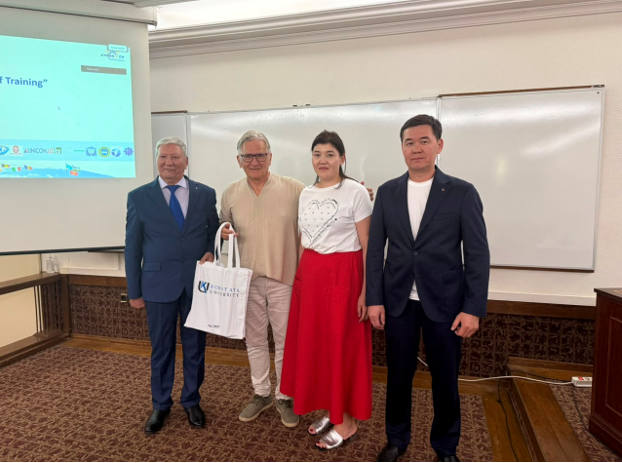
The Korkyt Ata Kyzylorda University was presented at the international event by:
Nurbek Kongyrbayev, Head of the Educational Program “Computer Science”, Associate Professor, PhD;
Asselkhan Adranova, Associate Professor of the Educational Program “Computer Science”, PhD;
Temirbolat Kenshinbay, Head of the Working Group for International Projects and Scholarship Programs, Institutional Coordinator of the Cyber4CA Project, Candidate of Philological Sciences.
Day One topic: European Experience in Cybersecurity Education
The program officially commenced with opening remarks delivered by representatives of Universidad Politécnica de Madrid, the European Union Regional Coordinator, the Cyber4CA Project Coordinator, and representatives of the Ministries of Higher Education of Kazakhstan, Uzbekistan, and Kyrgyzstan.
Participants attended comprehensive presentations on the Master's Program in Cybersecurity offered by Universidad Politécnica de Madrid. European experts introduced the curriculum structure, research activities, practical training model, cooperation with governmental agencies and industry, and the university's approach to educating highly qualified cybersecurity professionals. The delegation also visited the state-of-the-art laboratories and research facilities of ETSIT, gaining valuable insights into modern educational infrastructure and laboratory environments supporting cybersecurity education.
Day Two topic: Innovative Teaching Methods in Cybersecurity
The second day focused on advanced teaching methodologies and practical approaches to cybersecurity education. Specialists from the National University of Science and Technology POLITECHNICA Bucharest presented modern approaches to teaching Cloud Security and Internet of Things (IoT) Security, including the application of Federated Learning and hands-on laboratory exercises for anomaly and cyberattack detection.
A dedicated practical session addressed phishing awareness, where participants analyzed real phishing emails, examined email headers, practiced threat identification techniques, and discussed incident response procedures. Additional sessions explored international best practices in designing cybersecurity curricula, defining graduate competencies, and developing competency-based educational programs aligned with current industry needs.
Day Three topic: Designing CyberLab Infrastructure
The third day emphasized practical training and laboratory development. Experts from Scuola Superiore Sant'Anna (Italy) shared their experience in cybersecurity education for intelligent systems and introduced the university's innovation ecosystem supporting interdisciplinary research.
Participants engaged in practical laboratory exercises, including cybersecurity experiments, cryptography demonstrations, and the development of institutional CyberLab concepts. Interactive workshops enabled participants to design laboratory infrastructures tailored for master's degree programs in cybersecurity. The day concluded with group presentations, during which participants presented their proposed CyberLab models, discussed implementation priorities, identified potential challenges, and exchanged recommendations for establishing modern cybersecurity laboratories in their home institutions.
Day Four topic: Cyber4CA Consortium Coordination Meeting
On 18 June, project partners participated in the Cyber4CA Consortium Coordination Meeting, during which progress across all project work packages (WP1-WP6) was reviewed.
Discussions covered project management and financial coordination, analysis of cybersecurity-related study programs, development and implementation of master's curricula, establishment of CyberLabs, quality assurance mechanisms, dissemination strategies, and long-term project sustainability. Representatives of Central Asian partner universities shared updates on curriculum modernization activities and discussed future collaborative actions to ensure the successful implementation of project objectives across the region.
Day Five topic: Advanced Cybersecurity Laboratory Development
The final day focused on developing advanced cybersecurity laboratory infrastructures. Experts from the University of Antwerp (Belgium) presented modern laboratory environments for cloud computing, edge computing, IoT systems, virtual networking, container technologies, monitoring platforms, and software-defined infrastructures.
Participants designed laboratory modules suitable for integration into master's degree courses, discussed educational assessment methods, documentation standards, quality assurance procedures, and accreditation requirements. The program concluded with an interactive workshop dedicated to developing laboratory-based educational modules for Central Asian universities, followed by the official Certificate Award Ceremony recognizing participants' successful completion of the Teaching Staff Training Week.
Benefits for Korkyt Ata Kyzylorda University
Participation in the Erasmus+ Cyber4CA Training Week represents an important milestone in the internationalization strategy of Korkyt Ata Kyzylorda University. The knowledge and experience gained during the program will contribute to the development of an innovative master's degree in cybersecurity, the implementation of modern practice-oriented teaching methodologies, the establishment of a CyberLab at the university, and the expansion of international academic and research cooperation with leading European higher education institutions.
The outcomes of this international training will strengthen the university's capacity to educate highly qualified cybersecurity specialists equipped with the competencies required by Kazakhstan's digital economy and the wider Central Asian labor market. Furthermore, participation in Erasmus+ Cyber4CA reinforces the university's commitment to implementing European educational standards, promoting academic mobility, and enhancing the quality of higher education through international collaboration.
The Korkyt Ata Kyzylorda University Media Center
Services available
PLATONUS
platonus.kz
E-univer
https://e-univer.korkyt.kz/
The AI-Sana program
more...
МООK
МООK (Massive Open Online Lesson)
Megaproject Electronic Library
e-univer.korkyt.edu.kz
Erasmus
erasmus
Schedule of lessons
more...
Science Library
more...